


How to Support Local Communities in Africa with Every Purchase


Last Updated: 8 November 2026
Quick Summary
You support local communities in Africa with every purchase by buying fair trade artisan goods from sellers who name the workshop, state the country of manufacture, disclose materials, state a wage policy and offer clear returns. Ask who made it, what they were paid and how the seller knows. Regular orders give workshops a steadier base to plan from.
- Every purchase is a vote for the world you want, keeping money closer to the maker.
- Ask any seller who made the item, what they were paid and how they know.
- Our collars use Kenyan free-range beef leather, goat-skin lining and hand-cast recycled brass.
- Bespoke belts are made to order in Kenya and cannot be exchanged, so check the size chart.
- Community impact is cumulative: start with a collar, a lead or a belt you will use for years.
Table of Contents
- How Does Supporting Local Businesses Help the Community?
- Fair Trade African Products That Create Measurable Impact
- African Artisan-Made Accessories: Quality You Can Feel
- How Does Supporting Local Businesses Help the Community?
- Fair Trade African Products That Create Measurable Impact
- African Artisan-Made Accessories: Quality You Can Feel
- How Does Supporting Local Businesses Help the Community?
- Frequently Asked Questions
How Does Supporting Local Businesses Help the Community?
Every purchase is a vote for the world you want. When you support local communities in Africa through ethical shopping, money stays closer to the maker, paying fair wages and keeping workshops running. A regular order book beats a single large donation: predictability lets a workshop train apprentices and invest in tools.
Fair Trade African Products That Create Measurable Impact
Fair trade African products are made by artisans who receive a fair wage, work in decent conditions, and sell through transparent supply chains. The World Fair Trade Organisation's fair trade principles set out the standards a genuine fair trade business should meet. Two ranges show what transparent impact looks like: our EXTERNAL_LINK: Maasai beaded dog collars and Maragoli leather beaded dog collars, both beaded by named artisans in the Zinj Design workshop in Kenya.

When checking whether a product genuinely supports local communities, these are the signs the article says to look for.
What to check |
What good looks like |
|---|---|
Workshop |
A named workshop is given |
Country of manufacture |
Plainly stated |
Materials |
Disclosed |
Wage policy |
Stated |
Returns process |
Clear |
Seller questions |
Who made it, what they were paid, how you know |
African Artisan-Made Accessories: Quality You Can Feel
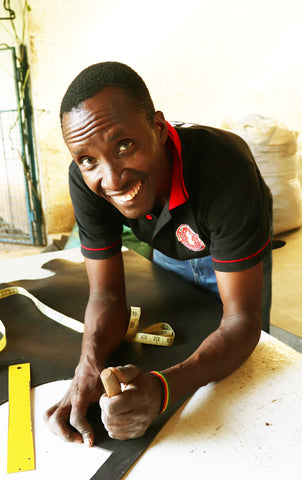
African artisan-made accessories are handcrafted by individuals, not assembly lines. Our collars use Kenyan free-range beef leather, a goat-skin lining, and solid brass hardware hand cast by local artisans from recycled brass; the glass beads are hand-stitched. See the Swahili leather beaded collars up close, and our customer service, delivery and exchanges guide for practical questions.

How Does Supporting Local Businesses Help the Community?
It keeps money in the local economy: steady sales fund fair wages, training, and local materials, and that spending circulates again. That means skills development for young people, stable livelihoods for beaders and leather cutters, and funding for school fees and household costs. The British Library's trade and empire collections offer useful historical context on why fair terms of trade matter so much across the continent.
Fair Trade African Products That Create Measurable Impact
Ask any seller three questions: who made this, what were they paid, and how do you know? A business that answers all three without hesitation is one you can trust. We publish the workshop and country of manufacture for every piece. Our bespoke belts are made to order in Kenya, and every purchase helps support local communities in Africa directly.
African Artisan-Made Accessories: Quality You Can Feel
Craftsmanship comes down to materials and time, and hand-finished pieces reflect the care that goes into each one. Check your dog's neck against the size chart before ordering, as each collar listing includes precise dimensions. Bespoke belts cannot be exchanged, so please check the size chart carefully before ordering.
How Does Supporting Local Businesses Help the Community?
Community impact is cumulative: each order is small, but regular orders give the workshop a steadier base to plan from. Start with a collar, a lead or a belt you will use for years.
The gap between a donation and a purchase is that a purchase repeats. If you want your dog's next collar to carry a fair wage, a named workshop and a lifetime guarantee with it, that is exactly what we make.
Get started with The Africa House and choose a handcrafted piece that supports local communities in Africa every time your dog wears it.
Frequently Asked Questions
How can I tell whether a product is fairly traded?
Look for specific evidence rather than vague labels. Check whether the brand names its supplier or workshop, states the country of manufacture, and explains how artisans are paid. The Africa House, for example, lists Zinj Design in Kenya as its factory and supplier, and describes fair wages and decent living conditions for producers. Ask directly about pay, working conditions and whether the craft is handmade or mass-produced. A brand that answers clearly and consistently is more trustworthy than one that relies on a 'fair trade' badge alone.
How does supporting local businesses help the community?
When you buy from a business that pays artisans fairly, the money stays in the local economy. Artisans can cover food, housing and school fees, and the workshop can invest in tools and training. The Africa House works with Zinj Design in Kenya, where makers such as Mary Kadowe, Harusi Wilson and Shida Hanga bead collars and belts. That steady work supports families and builds skills, which is community development in practice rather than a slogan.
Are African artisan-made accessories durable enough for everyday use?
The Africa House dog collars and leads use Kenyan free-range beef leather, a soft goat-skin lining, hand-cast recycled brass hardware and 100% glass beads that are hand-stitched. Every product carries a lifetime guarantee, so any damage or defect from normal use is replaced. Check the precise dimensions listed for each collar before ordering, especially for strong pullers or large dogs.
