


Are Leather Collars Good for Dogs? A Practical Guide


Last Updated: 4 November 2026
Quick Summary
Yes, for most dogs, leather collars are a strong, comfortable choice. Leather softens with body heat and coat oils, moulds to the neck, and lasts for years with basic care. Nylon suits dogs that swim daily or owners who want a quick-rinse collar.
- Good leather breaks in over a week or two of wear, while cheap leather stays stiff and cracks.
- A leather collar fits safely when two flat fingers slide between collar and neck.
- Clean leather with a damp cloth and mild soap, never soak it or machine wash it.
- Dry a wet leather collar flat, away from radiators, and recondition it once fully dry.
- Rolled leather collars suit long-haired breeds but concentrate load on a narrow band.
Table of Contents
- Leather vs Nylon Dog Collars: Which Material Suits Your Dog?
- The Best Collar Material for Dogs with Sensitive Skin
- Rolled Leather Dog Collar: A Better Fit for Long-Haired Breeds
- How to Fit a Leather Collar Safely: A Step-by-Step Check
- Caring for Leather: Cleaning, Conditioning and Wet Weather
- What Makes the Best Leather Dog Collars? Quality and Craftsmanship
- Choosing a Fairly Traded Leather Collar from The Africa House
- From Our Customers
- Frequently Asked Questions
Leather vs Nylon Dog Collars: Which Material Suits Your Dog?
Are leather collars good for dogs? Yes, for most dogs, leather collars are a strong, comfortable choice.
At The Africa House, we sell fairly traded leather beaded dog collars, so we have a clear interest here. We will still give you the honest comparison, drawbacks included.
The material you choose shapes comfort, safety and how often you replace the collar. Here is how the two stack up.
| Feature | Leather collar | Nylon collar |
|---|---|---|
| Comfort over time | Softens and moulds to the neck | Stays flat, can rub |
| Durability | Years with care | Frays and fades |
| Water exposure | Needs drying after a soaking | Dries fast |
| Cleaning | Wipe and condition | Machine washable |
| Look | Ages with character | Fades with sun |
Leather wins on comfort and lifespan. Nylon wins on water and mess. For a dog that walks, hikes and rolls in the mud, leather handles the wear well as long as you dry it properly.
A common mistake is buying a stiff, thick leather collar and expecting it to feel soft on day one. Good leather breaks in over a week or two of wear.
Watch out: a nylon collar left wet against the skin can cause chafing and a damp smell, so dry it after every soaking.
The Best Collar Material for Dogs with Sensitive Skin
For sensitive skin, smooth leather is often the best collar material for dogs. It sits flat, holds less trapped moisture than webbing, and softens so it rubs less. Rolled leather is even gentler on the neck.
Skin trouble usually comes from three things: friction, trapped damp, and hardware that sits against the coat. Leather addresses the first two well. It breathes better than coated fabric and does not hold water in the weave.
A few practical points matter more than the label:
-
Check the tanning process.
-
Look at the edges. Sealed, smooth edges rub less than raw cut edges.
-
Watch the dye. A cheap dyed collar can bleed onto pale coats. Wipe a new collar with a damp white cloth before first use.
If your dog has a diagnosed skin condition, ask your vet before changing collars. We can tell you what the material does. We cannot diagnose your dog.
Some dogs react to certain finishes or dyes rather than leather itself. If a new collar causes redness, remove it and try an undyed or naturally finished strap.
Rolled Leather Dog Collar: A Better Fit for Long-Haired Breeds
A rolled leather dog collar is a round-profile collar made from a rolled strip of leather. It suits long-haired breeds because the smooth round shape lets the coat lie over it instead of catching and matting around a flat strap.
Breeds with heavy feathering, like spaniels, setters and long-haired terriers, tend to collect knots under a flat collar. A rolled collar slides through the coat with less friction. It also looks neat on a dog that is mostly fluff.
Small long-haired breeds benefit most. A tiny dog with a big coat can end up with a collar buried in fur, which makes the buckle hard to find and the fit hard to check.
What most guides miss is that rolled collars are not ideal for every dog. A heavy puller needs a wider flat strap to spread pressure. Rolled leather concentrates load on a narrow band.
- Best for: long-haired breeds, small dogs, dogs that mat easily under a flat collar.
- Skip if: your dog pulls hard on the lead or has a very thick, heavy neck.
- Check the roll: a well-made rolled collar is firm and even, not lumpy.
Owners of small long-haired breeds can browse our small dog collars to see leather options in the right size range.
How to Fit a Leather Collar Safely: A Step-by-Step Check
A leather collar fits safely when you can slide two flat fingers between the collar and the dog's neck. Any tighter and it presses on the windpipe. Any looser and the dog can slip it.
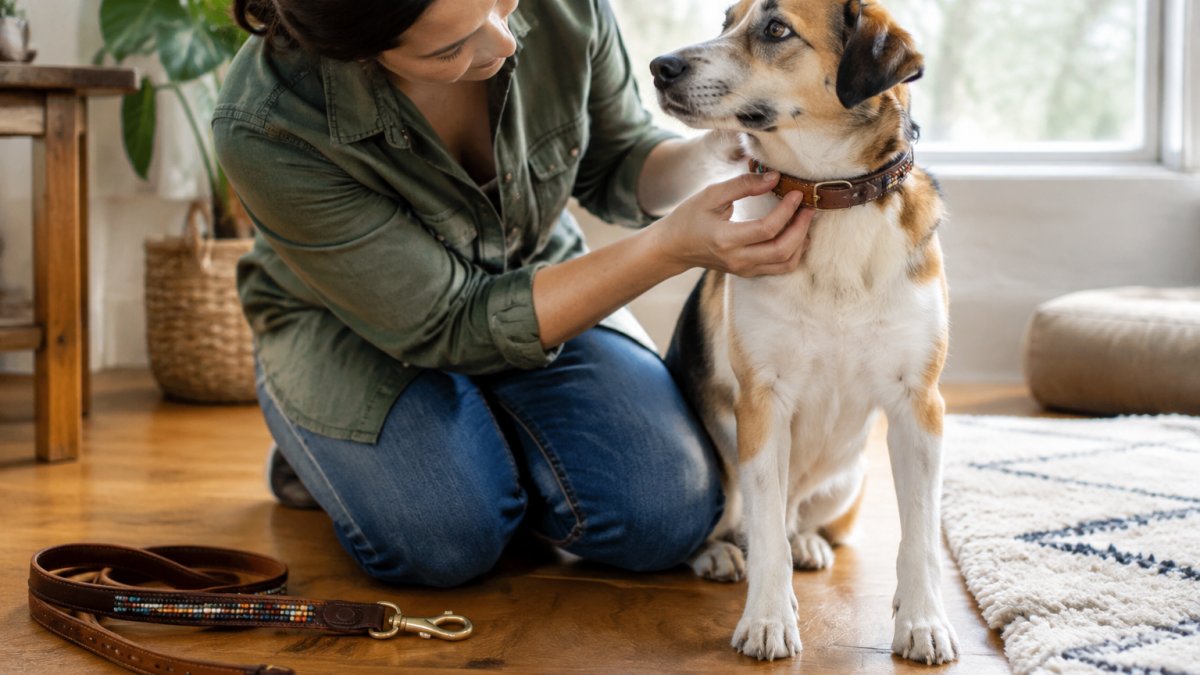
Measure the neck first. Use a soft tape around the middle of the neck, where the collar naturally sits, not up behind the ears. Add roughly two fingers of room. Write the number down and match it to the size guide.
Run this check every few weeks:
- Slide two fingers under the collar. They should pass with light resistance.
- Check the buckle holes. You want at least two spare holes either side of the current fit.
- Look for rub marks. Red patches or thinning fur mean the fit is wrong.
- Tug test. Gently pull the collar. It should not slide over the ears.
- Check the D-ring. It should sit on the side of the neck, not under the throat.
- Inspect stitching and hardware monthly. Loose stitches or a bent buckle mean replace the collar.
Puppies need this check monthly. Their necks grow fast, and a collar that fitted in spring can be tight by summer.
Watch out: a collar left on a crated dog can catch on bars. Remove it for crating and for rough play.
Once you know the size, shop by category so you buy the right strap width. Our medium dog collars and large dog collars pages list leather options by size.
Caring for Leather: Cleaning, Conditioning and Wet Weather
Leather lasts years if you clean it when dirty, condition it a few times a year, and dry it slowly after it gets wet. Skip those steps and it cracks, stiffens and splits at the buckle holes. The single biggest cause of premature leather failure is not cheap leather, it is a collar that was soaked and then left to dry against a radiator or in a damp bag.
Routine cleaning
Wipe the strap with a damp cloth and a little mild soap, a pH-neutral saddle soap or a diluted gentle hand soap is fine. Do not soak the collar, do not submerge it, and do not put it in the washing machine. Rinse the cloth, not the leather. Pay attention to the buckle holes and the fold around the D-ring, where grime collects and abrades the finish first.
For muddy walks, let the mud dry completely, then brush it off with a soft brush before wiping. Wiping wet mud just pushes grit into the grain.
Conditioning
Conditioning keeps the leather supple and replaces oils lost to water, sun and wear. Work a small amount of leather conditioner into the strap with a cloth, leave it to absorb for an hour or so, then buff off any excess. Do this every few months, and more often in dry winter air or after any soaking. Avoid neat oils and household polishes, they can over-soften the strap and stain the coat.
Wet weather and swimming: a drying routine
Leather is not a swimming collar. If your dog swims or gets caught in heavy rain, treat it as a drying job, not a wipe-down.
- Blot the collar with a towel as soon as you are back.
- Dry it flat, away from radiators, direct sun and hot cars.
- Never tumble dry, microwave or use a hairdryer, heat hardens leather and shrinks the strap.
- Once fully dry, recondition, because water strips the oils.
- Check the stitching and buckle holes before the next walk.
Salt from winter roads and sea water is worse than rain. Wipe it off the same day, then condition once dry. A wet collar left damp against the neck can stiffen overnight and rub, so dry it before the next walk if you can.
Watch out: a collar that has been soaked repeatedly and not reconditioned will feel stiff and may crack at the buckle holes, if you see hairline cracks, replace it rather than risk a break mid-walk.
If your dog swims most days, a leather collar is the wrong everyday choice. Keep the leather for dry walks and use a nylon or biothane collar for water days, rotating between the two.
What Makes the Best Leather Dog Collars? Quality and Craftsmanship
Full-grain leather keeps the strongest outer layer of the hide. Split leather and bonded leather are weaker and crack sooner. But most guides stop at the grade names, here is how to actually inspect a collar before you buy, and what UK law expects of the collar itself.
Reading the leather
- Full-grain leather keeps the tight outer grain. It is the strongest part of the hide, ages well and develops a patina.
- Top-grain leather is sanded to remove marks. It looks even but is slightly thinner in strength.
- Split and bonded leather are made from lower layers or scraps. They are cheaper and fail sooner.
Inspecting a collar in hand
Flip the collar over. The back of the strap and the inside of the buckle tell you more than the front.
-
Stitching: even, tight and finished with no loose threads. Look for a locked or bar-tacked join at the D-ring, which takes the most load.
-
Edges: sealed or burnished, not raw cut. Raw edges fray and rub.
-
Buckle holes: punched cleanly, not torn, with at least two spare holes either side of the current fit.
-
Strap feel: firm but flexible, not cardboard-stiff. A strap that creases sharply and stays creased will crack there.
-
D-ring: welded, not merely bent wire, and sitting on the side of the neck rather than under the throat.
Strength and the risk of breakage
Durability depends on the dog as much as the collar. A heavy chewer can damage any strap, so check for chew marks and replace at the first sign of deep nicks. A wide flat strap spreads load better than a narrow one for a strong puller, while a rolled collar concentrates load on a narrow band. Match the strap width to the dog, not to the look.
UK identification requirements
Check the current guidance on GOV.UK before you rely on any collar for identification, as requirements can change.
Watch out: a collar sold as "genuine leather" can still be bonded leather with a leather-look finish, if the cut edge looks fibrous and uniform rather than solid, it is not full-grain.
Choosing a Fairly Traded Leather Collar from The Africa House
Choosing a fairly traded collar means you can trace the craft and the wage behind it. Our collars are handmade by African artisans who are paid a fair wage, and all our products have a lifetime guarantee.
The difference shows in the beadwork and the leather. Each collar is handcrafted, so no two are identical.
-
"How do I know the money reaches the artisans?" Fair trade is the core of our model, and our producers are paid a fair wage.
-
"Will it hold up to a heavy puller?" Check the fit and the strap width for a strong dog, and inspect the stitching monthly.
-
"Why is it more than a pet shop collar?" You are paying for handmade craft and a fair wage.
-
"What if it does not fit?" Our customer service team can help with exchanges; see our delivery and returns terms.
You can browse our bespoke collars for made-to-measure sizing, and read our delivery and returns terms before you order.
From Our Customers
We do not need to invent proof. Our customers say it better.
One owner of a Labrador wrote that the collar arrived quickly, well packaged, with excellent communication throughout delivery. Another told us the service on a special order for a miniature schnauzer, and on replacing a lead with a minor defect, was exceptional. A third, who has three dogs and has used several suppliers, recommends us over all others.
Frequently Asked Questions
Are leather collars comfortable for dogs to wear every day?
Yes, leather collars are comfortable for daily wear once broken in. Leather softens with body heat and coat oils, moulding to the shape of your dog's neck over time. A properly fitted collar, with room for two fingers between the leather and the neck, prevents rubbing. Check the fit regularly as leather can stretch slightly with use.
How do you clean and condition a leather dog collar?
Wipe the collar with a damp cloth and mild soap, then let it air dry away from direct heat. Avoid soaking leather, as this can weaken the fibres. Once dry, apply a small amount of leather conditioner and buff it in with a soft cloth. Condition every few months, or more often if the collar gets wet or muddy. For heavy soiling, use a soft brush to remove dirt before wiping. Never use harsh chemicals or put a leather collar in the washing machine.
Is a leather or fabric collar better for dogs?
It depends on your dog's lifestyle. Leather is durable, moulds to the neck and looks smart, but it needs occasional conditioning and should not stay wet. Nylon and fabric collars are lightweight, quick-drying and easy to wash, yet they can fray and may hold odours. For everyday wear, many owners find leather collars comfortable and long-lasting. If your dog swims often, consider a water-resistant leather or a separate waterproof collar for those occasions.
How long should a leather dog collar last?
Leather collars can last for years with proper care. Lifespan depends on the quality of the leather, the stitching and hardware, and how often the collar is exposed to water or rough play. Chewing is the main cause of early replacement. Inspect the collar regularly for cracks, loose stitching or a stiff buckle. Conditioning keeps the leather supple and extends its life. All our products have a lifetime guarantee.
Your dog's collar takes more daily wear than almost anything else you buy for them, so it is worth getting right. If you want a collar that is comfortable, built to last and made by artisans paid a fair wage, The Africa House can help. Browse our handmade leather beaded collars, choose bespoke sizing for the perfect fit, and buy with the confidence of a lifetime guarantee and straightforward exchanges. Get started with The Africa House and give your dog a collar that lasts.
